


Choosing where to stay on the Costa del Sol is no longer a simple matter of picking any beach and hoping for the best. Search results for 2026 accommodation clearly divide the coast into distinct zones, and each one offers a different kind of holiday. Getting the location right is now a genuine pre-booking decision: it affects your airport transfer time, how easily you can explore by train, whether you can walk to dinner, how lively the nightlife will be and how often you will need a car.
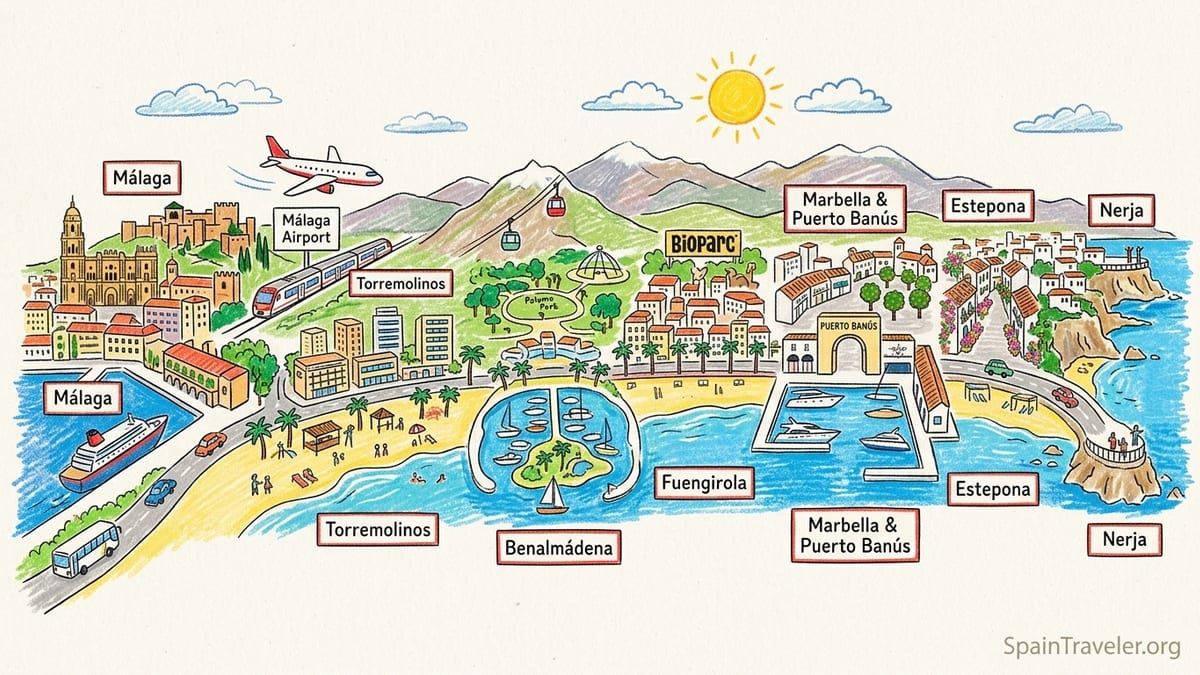
How to Choose Your Base on the Costa del Sol
The Costa del Sol stretches for roughly 150 kilometres from Nerja in the east to beyond Estepona in the west, and most visitors arrive through Málaga-Costa del Sol Airport. A coastal commuter rail line links the airport with Málaga city, Torremolinos, Benalmádena and Fuengirola, while express buses cover Marbella, Puerto Banús, Estepona and Nerja. Where you stay will shape not just your beach time but how much culture you see, whether nightlife is on your doorstep and how dependent you are on taxis or a hire car.
For culture and transport connections, Málaga city is the clear winner, with museums, historic streets and a major rail hub. Torremolinos is closest to the airport and often gives the best value at the beach. Benalmádena works especially well for families, thanks to its combination of marina, attractions and mid-range hotels. Fuengirola stands out for walkability, with a long seafront promenade and compact centre. Marbella and Puerto Banús offer luxury resorts and nightlife, Estepona brings a quieter upscale feel, and Nerja is the scenic choice that suits couples and slower stays.
Thinking about where you will spend your evenings is as important as the daytime picture. In some places you can stroll from your apartment to tapas bars, beach clubs and late-night cocktail spots in minutes. In others you might face a 20 to 30 euro taxi ride each way if you want more options. Before you book, it pays to balance airport access, public transport, restaurant density, noise at night and how much you want to drive.
Málaga: Best for Culture, City Buzz and Easy Transport
Málaga has transformed into a serious city-break destination, with a compact historic centre and a long list of museums. Around the Cathedral, the Alcazaba fortress and the Roman Theatre, the streets are packed with tapas bars and bakeries. Cultural heavy-hitters include the Picasso Museum, the Centre Pompidou outpost at Muelle Uno and the Carmen Thyssen Museum. You can spend days wandering between exhibitions and still be a 15 to 20 minute walk from La Malagueta beach or the urban Playa de la Misericordia.
From the airport, the local C1 commuter train runs directly to Málaga-Centro Alameda and María Zambrano in about 12 minutes, running roughly every 20 minutes from early morning to late evening. That means many city hotels are 20 to 30 minutes door to door from touchdown if you travel with hand luggage. María Zambrano is also the main station for high-speed and long-distance trains, so basing yourself in Málaga works very well if you want a few beach days before heading on to cities such as Madrid, Córdoba or Seville.
In terms of restaurants, Málaga offers far more variety than the smaller resorts. Around Calle Larios and Plaza de la Merced you will find everything from traditional fried-fish bars to contemporary tasting menus and rooftop cocktail terraces. A couple could easily eat out somewhere different every night for a week without repeating a street, with prices ranging from modest tapas at neighbourhood bars to more expensive fine dining. Nightlife is centred on the old town and the port, with busy terraces until late but generally less of the stag-party feel found further down the coast.
For many visitors, the advantage of staying in Málaga is that you do not need a car at all. You can walk to most sights, use the metro or buses for beaches slightly further out, and take day trips by train to Torremolinos, Benalmádena or Fuengirola. If you want a mostly cultural trip with occasional sea swims, this is the smartest base on the Costa del Sol.
Torremolinos: Best for Airport Convenience and Value
Torremolinos sits just south-west of the airport and is usually the first resort many visitors see as their plane comes into land. The same C1 commuter train that links Málaga with Fuengirola stops at the airport and then at several stations in Torremolinos, including the main underground station near Calle San Miguel. Travel time from the airport is about 10 minutes by train, and from Málaga city around 20 to 25 minutes depending on the stop. For anyone landing late in the evening or with young children, the ability to be at your hotel within half an hour of picking up luggage is a major selling point.
Torremolinos has a long, wide beachfront with several distinct areas. Playamar and Los Álamos attract a younger crowd, with modern chiringuitos that play music into the evening and offer cocktails and grilled fish a few steps from the sand. Closer to the centre, Bajondillo has more traditional seafront hotels and apartment blocks at a wide range of price points. In 2026, Torremolinos generally remains more affordable than Marbella, Benalmádena marina or central Málaga, particularly for simple beach-front studios and mid-range hotels with pools.
The town’s centre is fairly compact, though there is a noticeable hill between the clifftop streets and the beachfront promenade. Lifts and stairways connect the levels, but anyone with mobility issues may want to check the exact location of their accommodation. Restaurants lean towards casual Spanish and international holiday fare, with plenty of menu boards, daily specials and family-friendly options. Nightlife can be lively in summer, especially near Plaza Costa del Sol and Los Álamos, where beach clubs and bars stay open late.
Torremolinos works well if budget and convenience outrank atmosphere and scenery. You can use the train to make quick day trips into Málaga or along to Benalmádena and Fuengirola, and airport taxis are relatively inexpensive because of the short distance. A car is not essential unless you plan to explore rural inland villages or the eastern stretch towards Nerja.
Benalmádena: Best for Families and Resort Facilities
Benalmádena spreads across three main areas: the inland village of Benalmádena Pueblo, the residential core around Arroyo de la Miel and the coastal strip around the Puerto Marina. The C1 train stops at Arroyo de la Miel, roughly 20 minutes from Málaga Airport and 30 to 35 minutes from Málaga city, with frequent services. From there local buses and taxis run down to the seafront, where much of the accommodation is concentrated. For families, the combination of train access and resort infrastructure is a strong draw.
Along the coast you will find a high concentration of apartment complexes, aparthotels and mid-range hotels, many with pools and kids’ clubs. The Puerto Marina area, with its distinctive island-style apartment blocks and moored yachts, is especially popular with families who like having restaurants, ice-cream stands and boat trips at their doorstep. Attractions such as the Sea Life aquarium, the cable car up to Mount Calamorro and the large park at Paloma Park give you non-beach options within a short taxi or bus ride.
Restaurants in Benalmádena cater heavily to families and British and northern European visitors, so it is easy to find child-friendly menus, casual pizzerias and places serving familiar favourites alongside local seafood and tapas. The marina and the promenade come alive in the evenings but tend to feel more family-orientated than party-heavy. That said, there are still plenty of bars where you can stay out late if you want a nightcap after the children are in bed.
Benalmádena can work almost entirely without a car if you are happy to stay near the seafront and use the train or occasional taxi. However, its hilly layout and separated zones mean you should pay close attention to where your hotel or apartment is located. Families who prefer to avoid steep walks might favour properties directly on the flat promenade between the marina and Torremolinos, where pram-friendly strolls and immediate beach access are easy.
Fuengirola: Best for Walkability and an All-in-One Resort
Fuengirola is the final stop on the C1 train line from Málaga, around 30 to 35 minutes from the airport and roughly 40 minutes from Málaga city. The station sits just a couple of blocks back from the sea, and many hotels and apartments are within a 5 to 10 minute walk. The town is long and narrow, and almost everything is strung out along or just behind the Paseo Marítimo, a wide seafront promenade that runs for several kilometres.
This layout is ideal for travellers who like to do almost everything on foot. You can walk from one side of the resort to the other entirely along the promenade, passing sandy beaches, small chiringuitos, hotel bars and children’s play areas. There is a compact central area around Plaza de la Constitución with more traditional streets, but the overall feel is that of a practical, easy-to-navigate seaside town rather than a historic village. Supermarkets, pharmacies and casual restaurants are never far away, which suits longer stays and families on self-catering holidays.
Fuengirola offers a broad mix of dining options, from simple tapas bars on side streets to Indian, Italian and Scandinavian restaurants serving resident expats and repeat visitors. The nightlife is livelier than Benalmádena in places, with clusters of bars and small clubs near the port, though it does not usually reach the intensity of Puerto Banús in midsummer. Because the resort is flat, evenings spent walking out to dinner and back feel straightforward even for less mobile travellers.
You do not need a car if you base yourself centrally in Fuengirola, as the train station brings easy access to the airport, Málaga and other towns on the line. However, exploring further west to Marbella, Estepona or inland villages like Mijas Pueblo will require a bus or taxi. For many visitors, Fuengirola’s appeal lies in the combination of straightforward transport, walkability and a complete package of facilities without premium pricing.
Marbella & Puerto Banús: Best for Luxury, Beaches and Nightlife
Marbella has long been the Costa del Sol’s byword for glamour, and Puerto Banús is its most famous marina, lined with luxury yachts, designer boutiques and late-night bars. Unlike Málaga, Torremolinos, Benalmádena and Fuengirola, Marbella is not connected to the commuter rail network. Instead, express buses run from Málaga Airport to Marbella bus station, typically taking around 45 minutes to 1 hour depending on the service. From the bus station, taxis connect to hotels and apartments in both central Marbella and Puerto Banús in roughly 10 to 15 minutes.
Once in Marbella, you can broadly choose between staying near the atmospheric Casco Antiguo, the old town with its narrow streets and orange-tree-filled squares, or along the beachfront promenade. High-end resorts, boutique hotels and serviced apartments line the coast east and west of the marina, with some properties offering direct beach access and others set slightly back behind gardens and pools. In Puerto Banús, large resort hotels and modern apartments cluster around the port and along the Golden Mile, where beach clubs and chiringuitos edge the sand.
The restaurant scene here is broad and upmarket, ranging from chic beach clubs serving sushi and champagne to traditional tapas bars in the old town. You will find several Michelin listed venues, celebrity-chef restaurants and rooftop lounges alongside casual pizzerias and burger spots. Nightlife is among the liveliest on the coast in summer, with bars and clubs in Puerto Banús staying open until the early hours and beach clubs hosting regular DJ sets. Outside peak months, the scene calms but remains more sophisticated and dressy than the mid-range resorts.
Because local public transport is more limited than in the rail-linked towns, a car or frequent taxis become more relevant if you plan to explore widely. However, many visitors are content to stay within the Marbella and Puerto Banús corridor, walking or using short taxi rides between old town, marina and beach clubs. This area suits travellers who prioritize high-end accommodation, dining and nightlife and are comfortable with higher prices and occasional reliance on cabs.
Estepona: Best for a Quieter Upscale Stay
Further west from Marbella, Estepona has grown in popularity with travellers seeking a calmer, slightly less showy version of the Costa del Sol. The town has an attractive old centre with flower-decked streets, a redeveloped seafront promenade and a working marina. Many four-star hotels and upmarket apartment complexes stretch along the coastal road on both sides of town, often with landscaped gardens and direct or near-direct beach access. Compared with Marbella, the pace feels noticeably slower, especially outside the Spanish holiday peaks.
Estepona is not on the train network, so access from Málaga Airport is by road only. Direct buses connect the airport and Estepona, and many services run via Marbella, with typical travel times of around 1 hour 15 minutes to 1 hour 30 minutes, depending on stops and traffic. Private transfers and taxis are widely available but cost more due to the longer distance. Once there, if you choose accommodation near the old town or the marina, you can walk to plenty of restaurants and the main town beach. If you stay in one of the larger resorts several kilometres outside the centre, you might rely on hotel shuttles or taxis for evenings out.
Estepona’s restaurant offer is large enough for a week’s holiday without repetition, with seafood restaurants along the promenade, tapas bars in the old town lanes and more contemporary spots at the marina. Prices are often slightly lower than in central Marbella, especially away from the frontline. Nightlife is modest rather than intense, with a handful of late bars and seasonal beach clubs but a stronger focus on relaxed dinners and drinks. For many couples and families, this balance between comfort and calm is precisely the point.
A car becomes more useful in Estepona if you plan to explore widely, visit small coves along the coast or make side trips to inland villages and other provinces. However, if you select an in-town hotel or apartment, you can manage comfortably on foot and by occasional taxi. Estepona is well suited to travellers who enjoy a polished environment but prefer to sleep without the soundtrack of late-night clubs.
Nerja: Best for Scenery and Couples
At the eastern end of the Costa del Sol, Nerja offers a different mood to the busier western resorts. Whitewashed streets, low-rise buildings and dramatic views of the Sierra Almijara mountains set the backdrop. The Balcón de Europa, a headland promenade, looks out over small coves and clear water, and several beaches such as Burriana and Calahonda sit in sheltered bays. The area is especially popular with couples seeking a mix of beach time, light hiking and slower-paced evenings.
Nerja does not have a train station, so travel from Málaga Airport involves either driving east along the coastal motorway or taking a bus, usually via Málaga city. Depending on connections and traffic, the journey can take around 1 hour 15 minutes to 1 hour 30 minutes by car or a little longer by bus. The reward is a town that feels more compact and human-scale than many of the purpose-built western resorts, with most accommodation clustered within walking distance of the centre and the main beaches.
The restaurant scene leans heavily towards small, independently run places, from tapas bars hidden in side streets to seafront spots at Burriana Beach that grill sardines over open coals. In high season the area around the Balcón de Europa hums with activity, but the tone tends to be more low-key than Puerto Banús, with live music bars, wine bars and late cafés rather than large nightclubs. Many visitors here are couples and small groups who want to eat well, stroll the promenade and perhaps enjoy day trips to the Nerja Caves or the nearby village of Frigiliana.
Because Nerja’s centre is walkable and hilly rather than sprawling, a car is optional rather than essential if you plan mainly to relax. However, hiring one for a few days can unlock the countryside and give access to less crowded beaches and hiking trails in the Sierras de Tejeda, Almijara y Alhama Natural Park. For travellers who value scenery and atmosphere ahead of big-night-out options, Nerja stands out as one of the most appealing bases on the coast.
Which Costa del Sol Area Is Right for You?
Choosing between these bases comes down to your priorities. If culture and convenient onward travel matter most, Málaga city is the obvious choice, pairing an easy airport train link with museums and urban beaches. For quickest access to the sand and generally lower prices, Torremolinos is hard to beat, particularly if you arrive on a late or early flight. Families who want a resort feel with plenty of activities might gravitate towards Benalmádena or Fuengirola, trading some traditional charm for practical layouts and strong public transport.
Travellers chasing luxury, high-end dining and nightlife can focus on Marbella and Puerto Banús, accepting slightly longer airport transfers and more frequent taxi rides. Those looking for a more subdued yet still comfortable environment should consider Estepona, where the old town and quieter beaches encourage slower evenings. Finally, couples and scenery-seekers will likely find Nerja’s combination of coves, mountain views and intimate scale especially appealing, even with a longer journey from the airport.
Before you commit to a non-refundable rate, trace the route from Málaga Airport to your chosen hotel, check whether the C1 train or an express bus covers most of the distance, and look carefully at maps to see how far you will be from the beach and restaurants. On the Costa del Sol, the difference between a five-minute stroll and a 25-minute uphill walk can change how your holiday feels in practice.
FAQ
Q1. Which part of the Costa del Sol is best if I will not rent a car?
Málaga, Torremolinos, Benalmádena and Fuengirola work best without a car because all are linked by the C1 commuter train, which also serves the airport, and each has beaches, restaurants and supermarkets within easy walking distance of central accommodation.
Q2. How long does it take to reach Marbella from Málaga Airport?
Direct buses from Málaga Airport to Marbella bus station usually take around 45 minutes to 1 hour depending on the service and traffic, after which you should allow another 10 to 15 minutes by taxi to reach hotels in central Marbella or Puerto Banús.
Q3. Is Málaga city a good base for both beach and sightseeing?
Yes. Málaga combines an active cultural scene and historic centre with city beaches such as La Malagueta and Playa de la Misericordia, typically 10 to 20 minutes’ walk or a short bus ride from most central hotels.
Q4. Where should families with young children stay on the Costa del Sol?
Benalmádena and Fuengirola are especially family friendly, offering plenty of mid-range hotels and apartments with pools, long seafront promenades, attractions such as aquariums and parks, and straightforward train access from the airport.
Q5. Which area has the liveliest nightlife?
Marbella and Puerto Banús have the most concentrated high-end nightlife, with beach clubs, cocktail bars and late-night venues, while Torremolinos and central Fuengirola also offer busy bar areas that appeal to a broader range of budgets.
Q6. Is Estepona too quiet for a week-long stay?
For most travellers, Estepona offers enough variety for a week, with a pleasant old town, marina, promenade and a good number of restaurants, though nightlife is more relaxed than in Marbella or Puerto Banús, which suits visitors who prioritise calm over late clubs.
Q7. How difficult is it to reach Nerja from Málaga Airport?
Reaching Nerja requires either driving east on the coastal motorway or combining a transfer from the airport with a bus from Málaga, making the journey roughly 1 hour 15 minutes to 1 hour 30 minutes in normal traffic, so it is longer than trips to the main western resorts.
Q8. Which area is best for a romantic break?
Nerja and Estepona are both strong choices for couples, offering more intimate atmospheres, attractive old towns and scenic settings, with Nerja adding dramatic coves and mountain views and Estepona offering a polished but calmer seaside feel.
Q9. Are the beaches very different between these towns?
Beaches in Málaga, Torremolinos, Benalmádena, Fuengirola and much of Marbella are long and urban, fronted by promenades and lined with chiringuitos, while Estepona and Nerja offer a mix of town beaches and smaller coves, with Nerja’s coastline generally feeling more rugged and picturesque.
Q10. When is it worth hiring a car on the Costa del Sol?
Hiring a car is most useful if you stay in Marbella, Puerto Banús, Estepona or Nerja and want to make regular excursions along the coast or inland; in the rail-linked towns of Málaga, Torremolinos, Benalmádena and Fuengirola many visitors manage comfortably using trains, buses and taxis.