


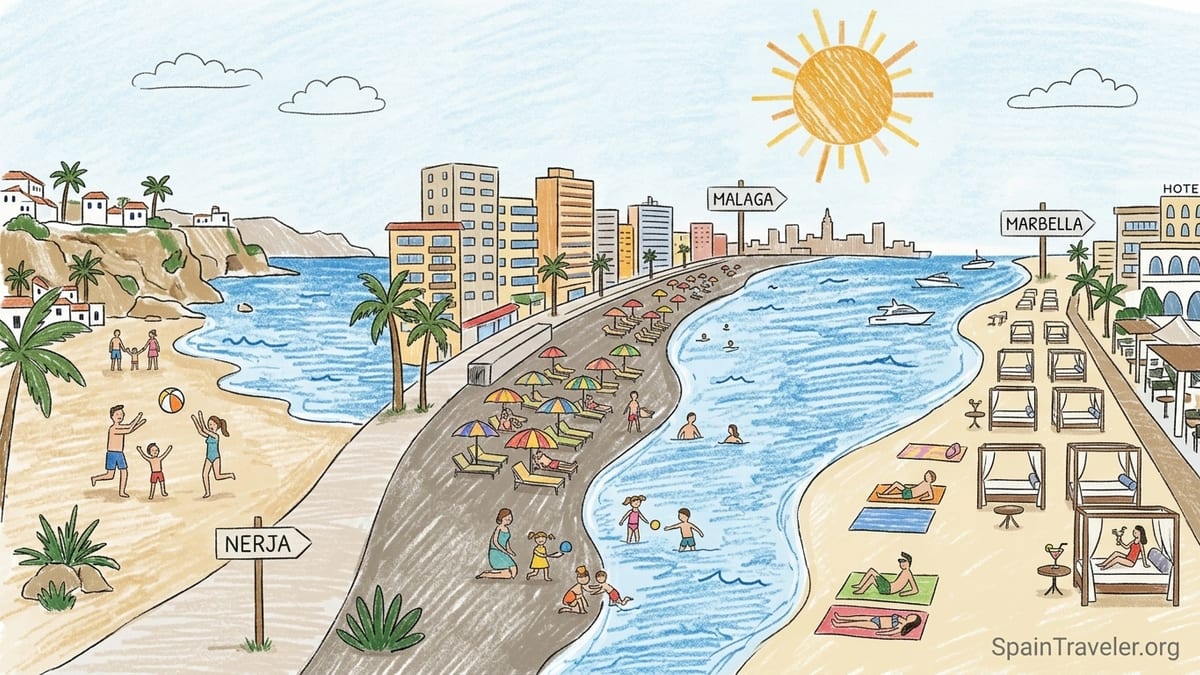
The Costa del Sol stretches for more than 150 kilometres, yet many guides talk about it as if it were one long, interchangeable strip of sand. In reality, the feel of Burriana Beach in Nerja is very different from La Malagueta in Málaga, or the beach-club coast of Marbella from the family promenades of Fuengirola and Estepona. If you are choosing where to stay, understanding how the sand, swimming conditions, facilities and overall atmosphere change from town to town is far more useful than scrolling through another list of pretty photos.
How the Costa del Sol’s Beaches Really Differ
From Nerja to Estepona, the Costa del Sol is often marketed as a single “sun and sand” corridor, but the beaches themselves serve very different kinds of trips. Burriana in Nerja still feels like a compact resort bay with cliffs behind and a relaxed, small-town atmosphere. By contrast, Málaga’s La Malagueta or the long sands of Fuengirola are thoroughly urban, backed by busy avenues, apartment blocks and year-round life. Marbella layers in an extra ingredient: a dense concentration of beach clubs and higher prices that shape who these beaches work best for.
Sand quality and water are another dividing line. In general, this coast has darker, often imported sand that can feel coarse compared with the white shores of Cádiz or the Balearic Islands. La Malagueta, for example, is known for its dark, greyish sand and occasional shingle, typical of Málaga’s urban beaches. Burriana in Nerja and La Rada in Estepona have lighter, finer sand by local standards, which many families find more comfortable for bare feet and sandcastles.
Then there is the question of facilities and atmosphere. Fuengirola’s seafront, for instance, runs for around 7 to 8 kilometres, almost all lined with chiringuitos, sunbed concessions and children’s play areas, making it one of the most intensively equipped stretches on this part of the coast. Marbella’s central beaches offer plenty of services too, but the front row is dominated by loungers and four-poster daybeds commanded by beach clubs, so the vibe and price point are different from the more down-to-earth promenades of Estepona or Torremolinos.
Thinking in terms of travel style rather than geography will help you decide where to base yourself. Do you want a relaxed bay where you can walk from apartment to family-friendly sand in a few minutes, or a city beach where you can combine museums and tapas bars with a daily swim? Are you the type who wants a different chiringuito every day or who is happy to return to the same favourite sunbed rental? The following sections compare the main resort bases by what their flagship beaches actually feel like on the ground.
Nerja and Burriana Beach: Clifftop Charm and Family-Friendly Sand
Nerja sits at the eastern edge of the Costa del Sol, where the coastal landscape becomes more rugged and mountainous. Burriana is its main “resort” beach, a broad curve of sand backed by a promenade of low-rise apartments, cafés and chiringuitos rather than high-rise hotels. Families often choose Nerja because the town centre still feels like a whitewashed Andalusian village, yet Burriana offers enough services to spend long days on the sand without needing a car.
The sand at Burriana is a mix of medium-grain, light brown sand and small pebbles, softer than many of Málaga’s darker urban beaches but not powdery. The sea usually shelves moderately, which suits older children and confident swimmers, though small kids may need a hand near the waterline when there is swell. In summer there are typically lifeguards, marked swimming zones and pedalo, kayak and stand up paddle rentals. Banana boats and similar tow rides sometimes operate from here, so expect some noise and boat traffic in high season.
Facilities are strong for a beach of this size. Along the promenade you will find several popular chiringuitos that locals recommend for paella and espeto-style sardines cooked over open fires, as well as ice cream shops and casual pizzerias. Sunbeds with parasols are usually rented by the day, and you can still find space on the sand with your own towel if you arrive before mid-morning in July and August. Showers, toilets and a few small playgrounds dot the promenade, and Nerja’s town centre is about a 15 to 20 minute walk or short taxi ride away.
Parking is the main practical issue at Burriana if you are staying elsewhere. There is a municipal underground car park and several small surface car parks and roadside bays near the beach, but on August weekends they often fill by late morning. If you plan to day trip from Málaga or another resort, it can be worth arriving before 10:00 or visiting outside peak Spanish holiday weeks. For travellers basing themselves in Nerja, the ability to stroll down from a nearby apartment and avoid the parking scramble is one of Burriana’s biggest advantages.
Málaga and La Malagueta: Urban Beach for City Breakers
La Malagueta is Málaga city’s iconic beach, a 1.2 kilometre strip of dark, imported sand that stretches between the port and the upscale La Caleta neighbourhood. It is the beach you see on postcards with the giant “Malagueta” letters, and it sits roughly a 10 to 15 minute walk from the old town. That makes it unusually convenient if you want a cultural city break with art museums, restaurants and nightlife, plus a daily swim without having to ride a train out to the suburbs.
The sand here is darker and heavier than visitors often expect: a mix of grey-brown grains and some shingle that can feel compacted underfoot. The upside is that it does not blow around too much on windy days, but it is not the soft, pale sand of more remote Mediterranean coves. The sea is usually calm and shallow for the first few metres, making it practical for a quick dip or short swim parallel to the shore. Like many urban beaches, it can feel crowded in high season and after-work hours, and water quality may fluctuate after heavy rain when runoff reaches the sea, so locals sometimes recommend swimming a little farther from the port if you are sensitive.
Where La Malagueta shines is convenience. The promenade is lined with chiringuitos where you can order grilled sardines, fried fish platters and simple salads, and sunbeds with umbrellas are widely available for a typical rate that might be around 15 to 20 euros for two loungers and a parasol in peak months. Behind the palm trees, a strip of cafés, supermarkets and apartment blocks means you are rarely more than a few minutes from an ATM, pharmacy or bakery. Showers, toilets, children’s play areas and sports courts are scattered along the sand, and city buses stop just behind the seafront.
If you are choosing a base, Málaga suits travellers who care more about food, culture and atmosphere than about having the softest sand. You might spend the morning touring the Alcazaba and Picasso Museum, then walk down for a couple of hours on La Malagueta, ending the day with tapas in Soho. Accommodation along the beach itself is largely in apartment-style buildings and a few higher-end hotels near La Caleta. If sea views are a priority, check whether your hotel is truly beachfront or a few streets back, since proximity makes a big difference to how easily you will actually use the beach.
Torremolinos: Playamar and La Carihuela for Wide Sands and Classic Resort Life
Torremolinos was one of Spain’s original mass-market beach resorts and it still feels built around the seaside. Its long waterfront is divided into distinct areas, with Playamar closer to Málaga and La Carihuela stretching west towards Benalmádena. Both are broad, gently shelving beaches with plenty of space, and both are backed by a continuous promenade lined with apartments, hotels and an almost uninterrupted run of chiringuitos, cafés and souvenir shops.
The sand along Playamar and La Carihuela is generally medium to dark and a little coarse but more comfortable than some of Málaga’s city beaches. The sea tends to be shallow near the shore, especially around La Carihuela, which has long appealed to families and older visitors who like the security of standing depth for quite a distance. On calm days the water is good for paddling and casual swimming, though waves and wind can pick up. In season there are lifeguard posts, buoyed swimming zones, pedalos and basic watersports such as paddle boards and kayaks available for rent.
Facilities are classic Costa del Sol resort style. In La Carihuela, closely spaced chiringuitos serve a mix of fried fish, seafood rice dishes and international staples like burgers and pizzas, and many rent sunbeds that are packed closely together in high summer. Playamar has a slightly more open feel, with grassed areas, children’s play parks and some beach bars that edge towards a younger, more nightlife-oriented crowd. Toilet and shower facilities are regular along the front, and Torremolinos town centre is only a short, though often steep, walk up from the seafront or a quick taxi ride.
Torremolinos suits travellers who want the archetypal Costa del Sol experience on a relatively accessible budget. With Málaga Airport just a few minutes away by train and a range of mid-range hotels and self-catering apartments along the promenade, it works especially well for families and groups who value wide beaches, easy access to supermarkets and a big choice of reasonably priced chiringuitos over boutique charm. If you want quieter surroundings, look at accommodation towards the La Carihuela–Benalmádena border rather than the busiest central strips.
Fuengirola: Long Urban Beaches and Flat Promenades for Families
Fuengirola is often described as one long beach with a town attached, and the reality is not far off. Its coastline runs for around 7 to 8 kilometres, broken into named sections such as Los Boliches, San Francisco and Carvajal. In practice, these form one continuous urban beach backed by a wide, level promenade that makes Fuengirola especially appealing for families with pushchairs, people with reduced mobility and travellers who like to walk or jog by the sea daily.
The sand in Fuengirola is mostly medium-grain and darker in colour, similar in look to other central Costa del Sol beaches but quite well maintained. Most stretches hold Blue Flag status in summer seasons, indicating a baseline of cleanliness and services. The water generally stays calm with a gentle slope into the sea, especially in more sheltered sections like Los Boliches, which many visitors describe as child-friendly. Because the beach is so long, it is often possible to find slightly quieter pockets simply by walking 10 to 15 minutes along the promenade away from the main pier and marina.
Facilities are one of Fuengirola’s strong points. Almost every few hundred metres you will find a chiringuito or café, many operating year-round, along with shower blocks, toilets and wooden walkways across the sand. Sunbeds and parasols are common and usually priced toward the mid-range compared with Marbella, and there are multiple accessible beach zones with amphibious chairs and staff support for people with reduced mobility in the main summer months. Small children’s play areas and exercise machines create informal hubs every so often along the promenade, which helps keep days varied without leaving the seafront.
Accommodation in Fuengirola is heavily concentrated along or close to the beach. Expect mid-rise apartment buildings, apart-hotels and a few larger resorts that sit directly on the promenade, particularly around Los Boliches and Carvajal. This layout suits travellers who want to step out of the lobby, cross a cycle lane and be on the sand within a minute or two. If you are planning a longer stay without a car, Fuengirola’s combination of train access to Málaga and the airport, its extensive beachfront and everyday services like supermarkets and pharmacies make it a practical base, even if the setting feels more functional than picturesque.
Marbella: Beach-Club Coast With Pockets of Simpler Sand
Marbella’s name is almost shorthand for the glam side of the Costa del Sol, and that reputation shapes how its beaches work in practice. The coastline within the municipality stretches for several kilometres and technically includes quieter areas like Cabopino and Elviria, but the central Marbella and so-called Golden Mile area are dominated by a mix of resort hotels, luxury villas and a dense run of beach clubs. Many visitors stay here not for exceptional natural beaches but for an atmosphere of upscale lounging, music and dining right on the sand.
The sand on central Marbella beaches is often a mix of medium-grain brown sand and pebbly patches, with some stretches reinforced by small breakwaters. Underfoot it can feel less uniform than in Fuengirola or on Burriana, and there can be occasional stones when you enter the water, so water shoes are useful for sensitive feet. The sea itself is usually calm with relatively gentle slopes, though some pockets deepen quickly. Swimming laps along the shoreline is possible, but you will share space with paddle boards, jet skis and boat traffic off the beach clubs during busier periods.
Facilities veer strongly towards the higher end. Along the central promenade and in hotspots such as Puerto Banús and the New Golden Mile, you will find beach clubs offering four-poster daybeds, table service and DJs, where a pair of loungers can easily cost from several dozen euros a day upward in high season. At the same time, there are still more basic chiringuitos and public sunbed concessions in between, but free, unoccupied sand can feel limited directly in front of the most popular clubs. Toilets and showers are available in many sections, and the promenade links up a chain of restaurants, cafés and shops that stay busy into the evening.
Choosing Marbella as a base makes most sense if beach-club culture is part of your plan or if you value being near golf courses, upscale dining and nightlife as much as the beach itself. Families on tighter budgets may feel they get better value in nearby towns while day-tripping to Marbella for a lunch on the promenade or a stroll through the old town. If you do stay on the beachfront, consider whether you prefer the livelier Puerto Banús area, central Marbella near the old town, or slightly quieter eastern suburbs like Elviria, which have a less club-heavy waterfront and sand that some visitors find more comfortable.
Estepona and La Rada: Softer Vibes and an Improved Seafront
Further west, Estepona has quietly evolved from a workaday fishing town into a popular base for travellers who want a softer, less hectic version of the Costa del Sol. La Rada is its main urban beach, running for around 2.5 kilometres alongside a modern promenade that links the marina to the old town. Compared with Marbella or Torremolinos, Estepona feels more relaxed and small-scale, with a historic centre full of flower-decked streets a short walk back from the sand.
The sand on La Rada is light grey and relatively fine by local standards, forming a broad, open strip that rarely feels hemmed in. The beach has repeatedly held Blue Flag status for water quality and services, and the sea here is generally suitable for swimming and paddling, though like all of the Costa del Sol it can be choppy on windy days. Lifeguards operate in season, and there are marked swimming zones, but the absence of heavy watersports right in front of the old town keeps the atmosphere calmer than in some resort areas.
Facilities along La Rada are comprehensive without feeling overbuilt. There are regular toilet and shower blocks, wooden walkways for easier access, children’s play zones and fitness equipment spaced along the front. Chiringuitos set directly on the sand serve grilled fish, salads and simple rice dishes, and they typically rent sunbeds and parasols that are often slightly less expensive than in central Marbella. Behind the promenade, low- to mid-rise apartment complexes and a handful of hotels give the town a more human scale than some of its neighbours.
Estepona works well for travellers who want to wake up by the sea but spend as much time strolling the old town or driving to nearby villages as lying on a lounger. Parking is easier than in some resorts thanks to underground car parks near the promenade, which is useful if you are day-tripping from elsewhere on the coast to sample La Rada. For longer stays, beachfront apartments near the old town give you direct access to the sand in minutes, while areas closer to the marina are convenient for evening drinks and boat trips.
Choosing Your Base by Beach Needs
When you compare these main Costa del Sol bases side by side, clear patterns emerge that can guide your decision. If you are travelling with young children and want flat promenades, accessible beach entries and playgrounds, Fuengirola and Estepona stand out. Both combine long, manageable beaches with practical services, supermarkets close to the sand and relatively straightforward parking or public transport. Nerja’s Burriana is also family-friendly but works best if you stay locally so that you can walk down and avoid parking issues.
For travellers who want to mix city culture with easy dips in the sea, Málaga is hard to beat. La Malagueta is not the softest or quietest beach on the coast, but its ten-minute walk from the historic centre means you can treat the sea as an extra activity rather than the entire focus of your trip. Torremolinos offers a more traditional beach-holiday atmosphere with wider sands and a dense run of chiringuitos, appealing to those who care more about sunbathing and social seaside life than museums or galleries.
If nightlife, beach-club lounging and people-watching are at the centre of your plans, Marbella is the natural choice. Its beaches may not be objectively better in terms of sand or swimming, but the concentration of high-end venues, bars and restaurants around the waterfront is unmatched on this stretch of coast. Estepona, by contrast, offers a gentler pace and a more local feel, making it a good option for couples and repeat visitors who have already ticked off the major sights and now want a comfortable, moderately priced base on a pleasant urban beach.
Ultimately, the “best” beach on the Costa del Sol depends less on grains of sand and more on what kind of holiday you want. An apartment two minutes from La Rada might beat a cheaper room inland from Marbella if your priority is long morning walks and easy swims, while a simple hotel a block from La Carihuela could be ideal if your dream is grilled sardines and wide sands with minimal planning. Use beach quality as one of several filters, alongside budget, transport and how much you enjoy busy nightlife, to settle on the stretch of coast that fits you best.
The Takeaway
Looking beyond glossy photos, the Costa del Sol’s main beach towns offer distinct trade-offs. Nerja’s Burriana balances small-town charm with a lively, well-equipped bay that works especially well if you stay within walking distance. Málaga’s La Malagueta delivers urban convenience and culture at the cost of softer sand and space. Torremolinos leans into classic resort life with wide, busy beaches, while Fuengirola and Estepona specialise in long, walkable promenades and everyday practicality.
Marbella, finally, is less about the innate quality of its sand and more about the scene that wraps around it: beach clubs, high-end dining and a name that carries weight. If you approach each town with these differences in mind, you can match your base not only to your budget but to the kind of days you actually want to live. For families and walkers, that might mean Fuengirola or Estepona. For short city breaks, Málaga. For nightlife-heavy weekends, Marbella or Torremolinos. With this more nuanced view, the Costa del Sol stops being a single “sun and sand” line on the map and becomes a set of distinct options tailored to very different kinds of travellers.
FAQ
Q1. Which Costa del Sol beach is best for families with small children?
Fuengirola and Estepona are excellent for families thanks to their long, flat promenades, accessible beach zones, playgrounds and generally gentle entry into the sea. Nerja’s Burriana is also family-friendly if you stay nearby and avoid having to drive and park every day.
Q2. If I want a city break with museums and a beach, where should I stay?
Málaga city is the strongest option. La Malagueta beach is about a ten to fifteen minute walk from the historic centre, so you can combine museum visits and tapas with a daily swim without needing a car.
Q3. Are Marbella’s beaches really better than those in other towns?
Marbella’s beaches are not necessarily better in terms of sand or swimming. What sets them apart is the density of beach clubs, upscale restaurants and nightlife along the waterfront, which appeals to travellers who value that scene.
Q4. Where will I find the softest sand on this stretch of coast?
The Costa del Sol largely has darker, medium-grain sand. Within the area covered here, Burriana in Nerja and La Rada in Estepona tend to feel slightly finer and more comfortable underfoot than some of the darker, compacted urban beaches in Málaga or central Marbella.
Q5. Which beaches are best if I am travelling without a car?
Málaga, Torremolinos and Fuengirola are all on the coastal train line, making their urban beaches easy to reach. Once based in any of these towns, you can walk straight from your accommodation to the sand and use trains or buses for day trips.
Q6. Where should I stay if I want quieter evenings but still good beach access?
Estepona and the eastern suburbs of Marbella, such as Elviria, tend to be calmer at night than central Marbella or main Torremolinos. Parts of Nerja away from the busiest bars also offer quieter evenings within walking distance of Burriana.
Q7. Are Costa del Sol beaches suitable for serious swimming, not just paddling?
Yes, on most days you can swim parallel to the shore along beaches like Fuengirola, La Malagueta, La Carihuela and La Rada. Conditions vary with weather, so choose mornings when the sea is calmer and stay within lifeguarded zones in summer.
Q8. Which area has the best choice of chiringuitos and casual beachfront dining?
Torremolinos, Fuengirola and Málaga all have dense runs of chiringuitos where you can eat grilled sardines, fried fish and salads right on the sand. La Carihuela in Torremolinos and Los Boliches in Fuengirola are especially good for hopping between options.
Q9. How important is parking when choosing a base on the Costa del Sol?
Parking can be a daily challenge in high season in places like Nerja’s Burriana or central Marbella. If you plan to drive, towns with more underground parking near the promenade, such as Estepona and Fuengirola, can make beach days noticeably less stressful.
Q10. If I want some nightlife but not all-night partying, which town should I pick?
Fuengirola and Málaga offer a good middle ground, with plenty of bars and restaurants that stay open late without the full-on clubbing reputation of parts of Marbella or the liveliest strips in Torremolinos.