


The modern Costa del Sol is no longer a single generic beach strip. It is a chain of distinct coastal towns, each with its own rhythm, price point and personality. Current hotel and rental inventories treat Málaga, Nerja, Marbella, Mijas, Estepona and Benalmádena/Fuengirola as separate micro-destinations, and smart travelers do the same. This guide focuses on what each place actually does best in 2026, with concrete examples of neighborhoods, prices and experiences, so you can build an itinerary that matches how you like to travel instead of chasing yet another endless list of sights.
Málaga: Cultural Capital With a Serious Food Scene
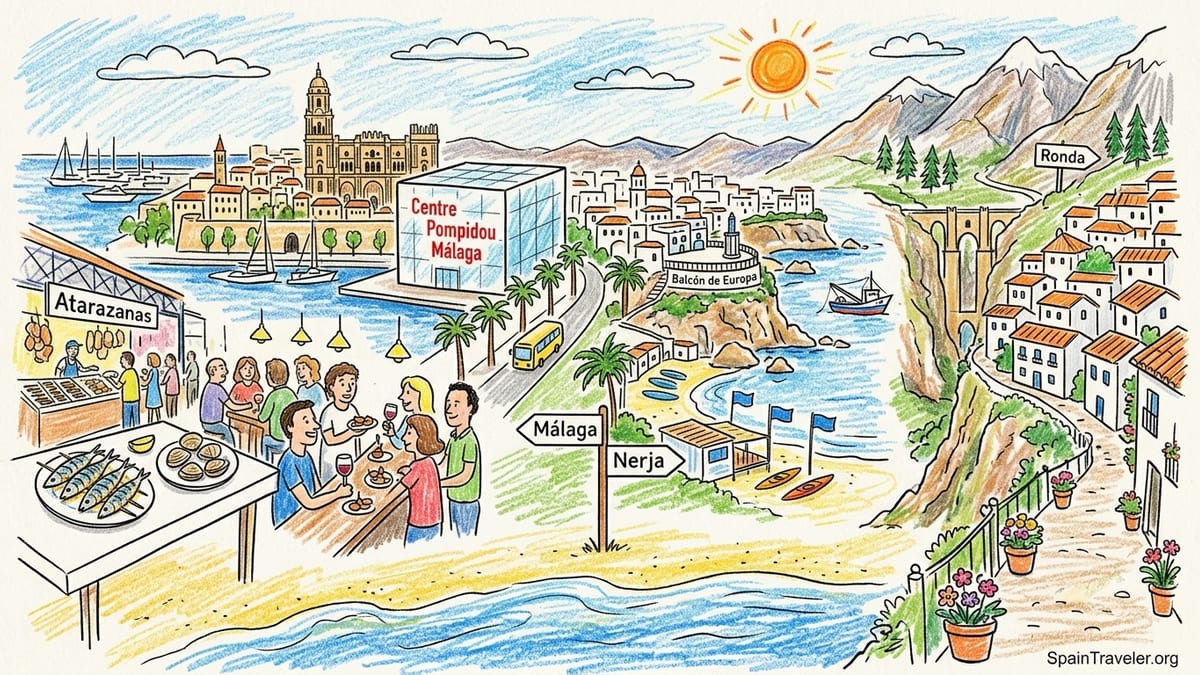
Málaga used to be treated as the airport for the Costa del Sol. Today it is the cultural and culinary anchor of the whole coast. The compact historic center around Calle Larios, the cathedral and Plaza de la Constitución is dense with museums, small galleries and tapas bars. Within a 10 to 15 minute walk you can visit the Picasso Museum, Carmen Thyssen Museum and the Museum of Málaga in the Palacio de la Aduana, then be back at a wine bar in time for an early evening vermut. The city’s port area, Muelle Uno, adds a contemporary promenade feel, with the Centre Pompidou Málaga housed in its glass “cube” just behind the waterfront.
A typical day for culture-focused travelers starts with a coffee and toast with tomato at a bar near Atarazanas Market, followed by a museum or two, then a slow seafood lunch. At Atarazanas, a plate of grilled squid and local clams at a simple stall can cost less than a sit-down restaurant on the coast, and you are eating shoulder-to-shoulder with office workers on their break. In the evening, locals still fill neighborhood tapas streets such as Calle Carretería and the Soho area, where contemporary street art sits beside classic bodegas pouring sweet Málaga wine.
Málaga also gives you a city-beach combination that works well for long weekends. Playa de la Malagueta and Playa de la Misericordia are not the prettiest beaches in Andalucía, but they let you move from museum to a sunbed in minutes. A deckchair and umbrella on Malagueta typically cost a modest fee for the day in high season, slightly less than the rates you will see in the upscale clubs in Marbella. For many travelers that practicality, combined with direct flights and high-speed rail to Madrid, makes Málaga an ideal base with day trips along the coast.
In price terms, Málaga usually sits between Nerja and Marbella. A mid-range hotel near the historic center often runs at a moderate nightly rate in summer, while pintxos or tapas in busy streets like Calle Granada can be as little as a few euros each. Craft cocktail bars and tasting-menu restaurants exist, but they are not the default. You can eat and drink very well here without leaning into luxury pricing, which is part of the city’s appeal for cultural travelers who want long museum days and relaxed, good-value evenings.
Nerja: Cliffs, Coves and a Classic Holiday Town
East of Málaga, Nerja marks the point where the Costa del Sol starts feeling wilder and more dramatic. The town itself is compact, built around the Balcón de Europa, a palm-lined viewpoint that looks straight onto cliffs and small coves rather than endless concrete. From here steps lead directly down to coves like Playa El Salón and La Caletilla, which are sheltered and feel almost enclosed by rock, especially outside school holidays.
Nerja’s main practical beach is Burriana, an 800 meter stretch of sand with full facilities, watersports kiosks and a Blue Flag distinction in recent years. Here you find kayak and paddleboard rentals, jet ski operators and chiringuitos grilling sardine skewers on little fishing boats set in the sand. A typical grilled-fish platter for two with drinks at a beachfront restaurant can sit at a mid-range price point, cheaper than an equivalent waterfront meal in Puerto Banús but more than a menu del día in inland villages. Sunbeds with umbrellas usually rent by the day at clear posted rates, and in high summer they often sell out by late morning.
What sets Nerja apart for many travelers is the combination of scenery and access to the protected coves in the Acantilados de Maro–Cerro Gordo natural area. Beaches like Maro, La Caleta or El Cañuelo are reached by steep paths or limited-access roads, and you feel that switch from resort coast to Mediterranean nature as soon as you start the descent. Kayak tours from Burriana or Maro often paddle along cliffs past small waterfalls and caves, giving a different perspective on the coast than you get from a promenade stroll.
The town retains a classic holiday feel. Streets around Calle Pintada mix souvenir shops with simple tapas bars where a beer and a tapa still come at reasonable prices. Rental supply here is heavy on small apartments rather than large full-service hotels, which suits couples or families looking for self-catering weeks. Nerja works best for travelers who value sea views, coves and a lighter, small-town atmosphere but who still want easy beach logistics and plenty of restaurant choice at mid-market prices.
Marbella & Puerto Banús: Polished, Upscale Coast Living
West of Málaga, Marbella and Puerto Banús are where the Costa del Sol leans fully into upscale travel. Marbella’s old town, with its orange-tree-shaded main square and narrow lanes, is still charming, but the modern identity of the destination is tied to the seafront promenade, luxury hotels and the Golden Mile that runs toward Puerto Banús. Here you find designer boutiques, fine-dining restaurants and beach clubs where a single sunbed with waiter service can cost as much as a whole simple lunch in Nerja.
Puerto Banús functions as the visual shorthand for this side of the coast. The marina is packed with yachts, and the front line features international luxury brands and late-opening cocktail bars. A simple coffee with a harbor view here often costs more than it would in central Málaga, and dinner at one of the high-profile restaurants can easily run to several times the cost of a similar meal in an inland town like Ronda. Travelers who enjoy people-watching, nightlife and a certain glamorous atmosphere tend to find this premium pricing part of the experience rather than a drawback.
Practically, Marbella and Puerto Banús work best for travelers who plan to spend on accommodation and dining and who prefer a service-rich environment. Many five-star properties here offer multiple pools, onsite spas, concierge teams that can arrange golf tee times and private drivers, and kids’ clubs in high season. The beachfront promenade supports long morning runs or bike rides, and you can walk from quieter stretches of sand into livelier areas with beach clubs playing music from afternoon onward.
Not every corner of Marbella is ultra-luxury. Neighborhoods slightly inland from the promenade or closer to San Pedro de Alcántara often have more residential rental options and local cafes where prices are closer to the Spanish average. Still, travelers drawn primarily by budget value usually find Estepona, Benalmádena or Fuengirola better matches. Marbella’s strength is clear: a polished resort infrastructure with upscale hotels, restaurants and nightlife that justify the higher rates for visitors who want that specific kind of coast break.
Mijas Pueblo: White-Village Charm Above the Coast
Mijas is technically a large municipality that stretches from the inland hills to the coast, where Mijas Costa and urbanizations between Fuengirola and Marbella are dominated by modern apartments. When travel companies list “Mijas” as a distinct destination identity, they are usually talking about Mijas Pueblo, the whitewashed village clinging to the hillside above Fuengirola. This is the place of narrow cobbled streets, geranium-filled balconies and viewpoints looking down over the entire strip of the Costa del Sol.
Compared with large resorts, Mijas Pueblo is heavily oriented toward day visitors, but there is a small stock of guesthouses and boutique hotels that let you stay after the buses leave. In the early evening, when the last group tours head back down to the coast, the town slows to a local rhythm. You can sit in a small square with a glass of wine at prices more in line with inland Andalucía than the big-name beach clubs. Dinner might be a simple grilled meat or fish at a family-run restaurant, at less than the price of a comparable dish on Marbella’s main promenade.
For many travelers, Mijas Pueblo works best as a contrasting overnight or as a repeat evening trip if you are based in Benalmádena or Fuengirola. You trade immediate beach access for cooler air and views back to the sea. Hikers use the village as a starting point for waymarked trails along the Sierra de Mijas, while others are content with wandering lanes lined with craft shops and churches. The atmosphere is more curated than in lesser-known inland villages, but it still delivers the white-village image many visitors imagine when they think of southern Spain.
When planning, it helps to treat “Mijas Pueblo” and “Mijas Costa” as separate ideas. Mijas Costa is essentially an extension of the coastal apartment strip, convenient for long self-catering stays but similar in feel to other built-up parts of the coast. Mijas Pueblo, by contrast, is about hilltop views, white houses and evening light on the church towers. Travelers who respond to that image will usually want at least one unhurried visit, even if they are sleeping somewhere closer to the water.
Estepona: Polished Yet Quieter Resort Alternative
Further west, Estepona has quietly repositioned itself from a working fishing town to a more polished but still relaxed resort. The old town is one of the most attractive on this stretch of coast, with streets systematically renovated and lined with colorful flowerpots, and with murals and small sculptures scattered through residential areas. Cafes spill onto pedestrianized squares, and the atmosphere in the evening is more Spanish-family-out-for-a-stroll than international party strip.
The waterfront has also seen investment. A long seafront promenade runs alongside a wide town beach, with chiringuitos that serve grilled fish and paella at prices typically lower than the prime beachfronts of Marbella. Travelers often notice that, in high season, you can still find room to spread out on the sand here without walking far from the center, which makes Estepona appealing for those who want sea and sun without the density and volume of music that can characterize some neighboring resorts.
Accommodation stock in Estepona ranges from all-inclusive hotels on the outskirts to small boutique properties in the old town. Nightly rates tend to be lower than comparable offerings in the Golden Mile or Puerto Banús, particularly outside peak school holiday weeks. A family might rent a modern two-bedroom apartment within walking distance of both beach and old town for less than the cost of a similar property nearer Marbella’s marina. This price differential is one reason some long-stay visitors and retirees base themselves here for months at a time.
Estepona works especially well for travelers who want an attractive, walkable town with a sense of place, but who do not need the nightlife intensity or brand-name dining of Marbella. You can still drive to Puerto Banús in well under an hour for a night out or shopping, but day to day you are more likely to be walking to the market, ordering coffee where the staff recognize regulars, and using the promenade for evening strolls rather than bar-hopping routes.
Benalmádena & Fuengirola: Practical, Well-Serviced Beach Holidays
Between Torremolinos and Mijas Costa, the neighboring resorts of Benalmádena and Fuengirola function as the workhorses of the Costa del Sol’s package and family market. Both are on the coastal railway line that runs between Málaga and Fuengirola, which means travelers can land at Málaga Airport and be checking into a seafront hotel in under an hour without renting a car. For many visitors, that convenience, combined with competitive prices and long, sandy beaches, is the primary draw.
Benalmádena combines a marina, a long beachfront and hilltop neighborhoods such as Benalmádena Pueblo. The marina area is dense with bars, casual international restaurants and family attractions, while the main beach has a continuous run of sunbed concessions and chiringuitos. Prices for food, drink and accommodation here are typically lower than in Marbella and slightly higher than in some parts of inland Andalucía, making it a solid middle-of-the-road option. You might pay a moderate amount for a seafront hotel room in July that would buy you only a basic room far from the water in a more exclusive resort.
Fuengirola, directly to the west, is more linear, built along a straight run of seafront backed by apartment blocks and hotels. The town has invested in its promenade and beach facilities, but the atmosphere is still more practical holiday town than boutique destination. Families appreciate the predictable setup: plenty of supermarkets for self-catering, a concentration of casual restaurants near the port and along the paseo, and a train station in the center. If you want to spend most of your time on the sand, with occasional easy day trips to Málaga, Mijas Pueblo or even Marbella by public transport, this area makes logistics straightforward.
Compared with Nerja or Estepona, Benalmádena and Fuengirola feel less scenic and less traditionally Spanish, but they compensate with infrastructure: water parks nearby, mini-golf, English-language services and year-round businesses that cater to repeat visitors and expatriate residents. For many travelers, especially those watching budgets or traveling with children, the reliability and simplicity of these towns outweigh the lack of dramatic scenery.
Ronda: Inland Excursion Above the Gorge
Ronda is often labeled as if it were another coastal town, but it sits high inland, around 60 kilometers from the sea as the crow flies and considerably more by road. Rather than squeezing it into a coastal hotel search, it makes more sense to treat Ronda as a distinct inland excursion. From Marbella or Estepona the drive usually takes around 60 to 90 minutes, climbing into the mountains with viewpoints back toward the Mediterranean, while from Málaga it is a longer cross-country route.
The town itself is famous for the Puente Nuevo bridge spanning a deep gorge and for its tightly packed old center. A typical visit involves walking the bridge viewpoints, exploring the old streets and maybe touring the bullring museum, then having lunch in a restaurant that looks back across the gorge. Prices for meals and coffee in the main tourist streets align broadly with other well-known Andalusian towns, though if you step a few blocks away from the principal viewpoints you usually find more local cafes with slightly lower prices.
Many travelers choose to visit Ronda as a day trip by rental car or as part of an organized excursion that also includes one or two white villages on the return route. Another option is to spend a night to enjoy the town once day-trippers leave and the gorge is lit up in the evening. Either way, it functions as a contrast to the Costa del Sol: same region, different landscape and pace. Treating it as an add-on rather than a coastal base keeps your planning more realistic and avoids the common mistake of assuming it lies somewhere along the beach strip.
The Takeaway
Planning the Costa del Sol in 2026 is less about covering every town on the map and more about matching each place’s identity to your priorities. Málaga now anchors the region as a cultural and culinary city with beaches attached. Nerja focuses on scenery and coves, blending a traditional holiday town with access to protected cliffs and clear-water bays. Marbella and Puerto Banús specialize in polished, upscale resort life with prices to match, while Mijas Pueblo offers a hilltop white-village atmosphere just above the coast.
Estepona positions itself as a quieter but increasingly refined resort, with an attractive old town and a more relaxed promenade, and Benalmádena/Fuengirola provide straightforward, practical beach holidays that make sense for families and value-conscious travelers. Ronda, meanwhile, belongs on your list as an inland excursion, not as a beach base, giving you a different face of Málaga province high above its famous coast.
The inventories of hotels, rentals and tour products already reflect these divisions, and building your itinerary around them makes the region easier to understand. Instead of chasing a long attractions list, decide whether you want galleries and tapas bars, cliff-backed coves, marina nightlife, white-village alleys or just a reliable sunbed a short train ride from the airport. The Costa del Sol can deliver all of these, but rarely all in the same place, and that is exactly what makes combining its towns so rewarding.
FAQ
Q1. How many days should I spend on the Costa del Sol for a first visit?
For a first trip, many travelers find 7 to 10 days ideal, which allows 3 nights in Málaga plus time split between an eastern base like Nerja and a western base such as Marbella or Estepona, with a day reserved for an inland excursion to Ronda.
Q2. Is it better to stay in Málaga or in one of the beach resorts?
If you prioritize museums, food and nightlife with city energy, Málaga works best as a base. If you mainly want to walk from your hotel straight onto a long sandy beach and are less interested in cultural sights, resorts like Benalmádena, Fuengirola or Estepona can be more convenient.
Q3. Do I need a car to explore these destinations?
You can manage without a car if you base yourself near the coastal railway in Benalmádena or Fuengirola and use buses and trains to reach Málaga and some nearby towns. A rental car, however, makes it easier to combine Nerja, inland villages and Ronda on your own schedule, especially if you want to visit smaller coves and viewpoints.
Q4. When is the best time of year to visit the Costa del Sol?
Late spring and early autumn are often the most pleasant, with warm sea temperatures, long daylight and fewer crowds than in July and August. Winter can be mild and sunny, especially for walkers and city-focused travelers, though some seasonal beach businesses reduce hours outside the main summer season.
Q5. How does Nerja compare to Marbella for families?
Nerja tends to suit families who value scenery, coves and a small-town feel, with plenty of apartments and mid-range restaurants. Marbella and Puerto Banús better fit families seeking resort-style hotels with pools, kids’ clubs and a wider choice of upscale dining and shopping, though at generally higher prices.
Q6. Is Estepona really quieter than the larger resorts?
Estepona’s old town and main beachfront feel busy in high season but usually calmer and more local than the nightlife strips of Marbella or Benalmádena. You will find lively bars, yet the overall emphasis is on evening strolls and outdoor dining rather than late-night clubs and loud beach parties.
Q7. Which town is best if I am traveling without a car?
Benalmádena and Fuengirola are particularly convenient without a car because both connect directly to Málaga Airport and Málaga city by train. From either town you can reach Mijas Pueblo by bus and take organized excursions to places like Ronda, while still having everything you need within walking distance of the seafront.
Q8. Can I visit Ronda as a day trip from the coast?
Yes, Ronda is a classic day trip from Marbella, Estepona or even Málaga, reachable by organized excursion or rental car. Many travelers leave the coast in the morning, spend several hours exploring the bridge, old town and viewpoints, have lunch, then return to their coastal base by evening.
Q9. Are the beaches around Nerja suitable for people with limited mobility?
Burriana Beach in Nerja offers better access and more level ground than some of the smaller coves, which often involve steep paths or stairs. Travelers with limited mobility generally find the long, flatter promenades and beaches of Benalmádena, Fuengirola or Málaga city easier to navigate.
Q10. How expensive is eating out along the Costa del Sol?
Costs vary by town and type of venue. Simple tapas bars in Málaga or Mijas Pueblo can be relatively affordable, while waterfront restaurants in Puerto Banús or high-end beach clubs often charge premium prices. In most destinations you can keep meals reasonable by choosing daily menus, avoiding the most touristed front-line spots and mixing sit-down dinners with casual lunches at markets or chiringuitos.