


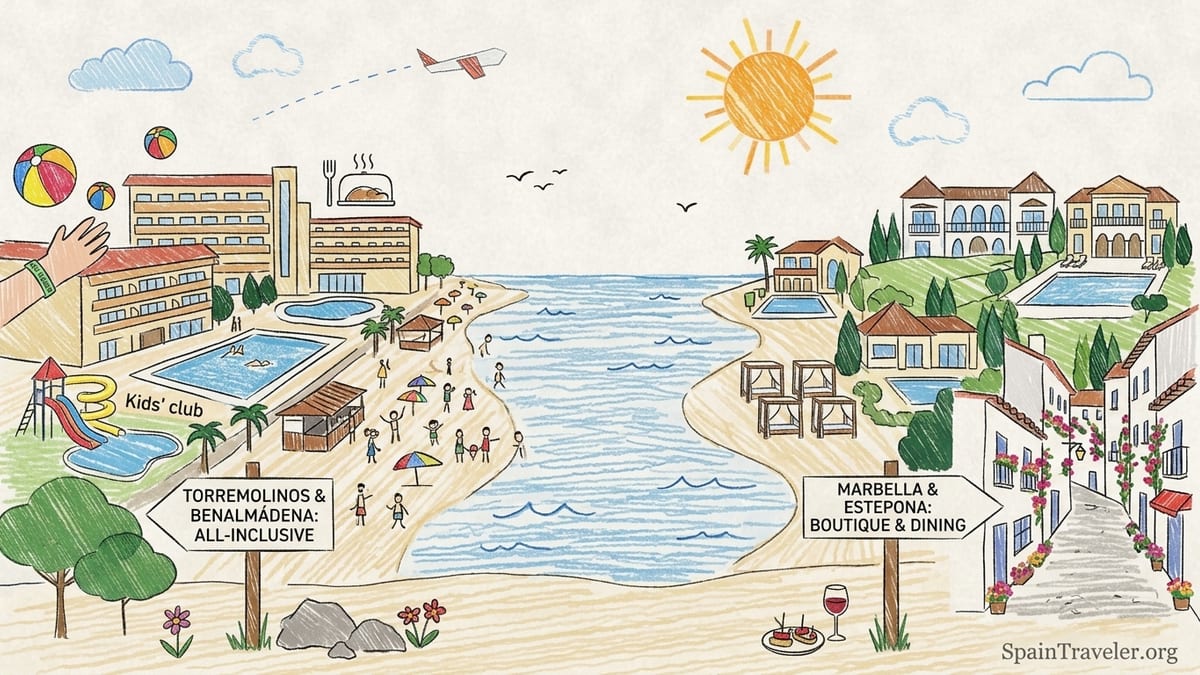
Costa del Sol has long been one of Europe’s classic sun-and-sand escapes, but not all all-inclusive resorts here are created equal. Torremolinos and Benalmádena have become the main hubs for family-friendly, buffet-driven all-inclusive breaks, while the more upscale Marbella–Estepona corridor leans toward stylish beach clubs, à-la-carte dining and flexible meal plans. Understanding how the different resorts approach food, drink, kids’ facilities and beach access can help you decide not only where to stay, but whether all-inclusive or half-board genuinely suits the kind of holiday you have in mind.
All-inclusive on the Costa del Sol: How the main hubs differ
If you look at current package holiday inventories from major operators, Torremolinos and Benalmádena clearly stand out as the main all-inclusive centers on the Costa del Sol. Large beachfront properties such as Hotel Riu Costa del Sol in Torremolinos offer 24-hour all-inclusive, multiple buffet restaurants and several bars, aiming squarely at guests who want to stay on property most of the time. This is where you find classic package-holiday energy: daytime pool games, kids’ clubs, evening shows and long buffet lines at peak dinner hours.
Benalmádena, a few minutes along the coast, has followed a similar path but with a strong focus on families and water play. Resorts like Holiday World Resort, often sold through tour operators with all-inclusive and half-board options, package together kids’ clubs, themed pools and access to splash areas or small water parks, which makes the town particularly attractive for families who want everything on site. The nearby Puerto Marina and Benalmádena Pueblo give options for days out, but the resorts are generally designed so you do not have to leave for meals or drinks if you do not want to.
By contrast, the Marbella and Estepona coastline is dominated by a mix of upscale hotels, boutique beach resorts and apartment-style complexes, many of which emphasize flexible meal plans rather than strict all-inclusive. Properties such as METT Hotel & Beach Resort Marbella – Estepona, for instance, focus on stylish pools, beach clubs and high-quality restaurants, and often attract guests who are more likely to dine along the Golden Mile or in Estepona Old Town than to rely on buffets every night. All-inclusive here, where available, tends to be more premium in style or limited to selected restaurants and hours.
For travelers trying to choose, this means Torremolinos and Benalmádena are currently the strongest options for true, everything-included stays, while the Marbella–Estepona corridor often works better for those who prioritize local restaurants, nightlife and a more varied dining scene over having every drink prepaid.
Buffet versus à-la-carte: What “all-inclusive” really buys you
In Torremolinos and Benalmádena, most all-inclusive packages are still fundamentally buffet-based. At larger beachfront properties, breakfast, lunch and dinner are typically served in one or two main buffet restaurants with live cooking stations for items like grilled fish or fresh pasta. At Hotel Riu Costa del Sol in Torremolinos, for example, guests find several themed restaurants but the core of the experience remains unlimited buffet dining and snacks throughout the day. You can usually expect a rotating selection of Mediterranean dishes, familiar British and northern European comfort food, salads and desserts, with some themed nights such as Spanish or Italian evenings.
Benalmádena’s family resorts tend to follow a similar model. At Holiday World Resort, and at big seafront properties like Estival Torrequebrada, the all-inclusive package revolves around buffet meals and poolside snacks, occasionally complemented by one or two specialty restaurants. À-la-carte options may be available, but the number of included à-la-carte dinners per week is often capped, for example at one or two reservations for a seven-night stay, with additional visits charged as extras. Travelers should read the current meal-plan descriptions carefully and check whether branded drinks, room service or certain restaurants carry surcharges.
Along the Marbella–Estepona strip, a growing number of hotels mix buffet breakfasts with à-la-carte lunches and dinners, especially in properties with strong beach club identities. You may find that an all-inclusive or “dine-around” package includes a buffet breakfast plus a choice of à-la-carte restaurants for other meals, but even then, the fine print often limits specialty items or premium wines. This style suits travelers who care more about food quality and atmosphere than about maximizing the number of daily snacks. Those who plan to spend most evenings exploring tapas bars in Marbella Old Town or beach chiringuitos in Estepona will often be better served with bed and breakfast or half-board rather than paying for three daily meals they will not use.
In practical terms, a buffet-centered all-inclusive will appeal to families with fussy eaters, who appreciate the ability to sample different dishes without worrying about individual prices. Foodies, or couples planning to dine out in places like La Carihuela’s seafood restaurants in Torremolinos or the marina restaurants in Benalmádena, may find that half-board or even just breakfast included leads to a better balance of value and variety.
Drinks, bars and the small print on “unlimited”
When comparing all-inclusive resorts in Costa del Sol, the drinks policy is just as important as the food. In Torremolinos, fully all-inclusive properties like Riu Costa del Sol tend to offer a straightforward package: soft drinks, draft beer, house wine and basic spirits are included throughout the day in a choice of bars, sometimes including a 24-hour sports bar. This suits guests who want to know that poolside cocktails, evening gin and tonics and even late-night snacks are already covered, with no bar bill to sign at checkout.
Benalmádena’s larger resorts usually follow a similar structure but may differentiate between local and imported brands. At some hotels, cocktails with premium spirits or bottled beers are not part of the standard all-inclusive and are charged separately, as are minibar items. Holiday World and other large family resorts sometimes also limit drinks at the water park or beach club to self-service soft drinks and draft options, with branded or packaged items paid for separately. It is worth asking at check-in where your wristband covers drinks and whether there are time restrictions, such as alcoholic drinks being available only from mid-morning until late evening, in line with local regulations.
In the Marbella–Estepona corridor, where high-end beach clubs are common, the situation can be more nuanced. Some properties that advertise “all-inclusive” or “full board plus” may include house drinks only at mealtimes, while pool and beach bars run as mostly pay-as-you-go venues. In others, a basic drinks package is included but premium cocktails at the beach club or rooftop bar are priced separately. Travelers who imagine drinking premium cava and signature cocktails all day at no extra cost are more likely to find what they are looking for in Torremolinos or Benalmádena’s classic all-inclusive resorts than in many of Marbella’s design-led hotels.
The key point is to treat “unlimited” with caution. Before you book, check whether coffee capsules in the room, fresh juices at breakfast or branded spirits are actually covered. In many cases, a mid-range all-inclusive will give you solid value on soft drinks, beer and basic spirits, while still encouraging you to pay extra for anything more specialized.
Kids’ clubs, splash areas and entertainment: where families win
For families, the biggest difference between regions on the Costa del Sol often lies in how fully the resorts are geared toward children. Torremolinos and Benalmádena have some of the coast’s strongest dedicated family offerings, which is reflected in how tour operators promote them. TUI, for example, highlights both towns as main bases for its family-branded hotels with kids’ clubs and animation. Riu Costa del Sol in Torremolinos offers a children’s pool with slides, a kids’ club and a packed entertainment schedule, while Benalmádena properties like Holiday World Resort and Estival Torrequebrada draw repeat guests with their combination of splash parks, kids’ pools and organized activities.
At these properties, families can expect morning kids’ club sessions for ages roughly 4 to 12, mini-discos in the evening and daytime activities such as water polo, crafts and treasure hunts. Many resorts also provide family rooms with bunk beds or sofa beds, children’s buffet sections with simpler dishes and early dinner sittings that suit younger bedtimes. For parents who want to relax by the pool while their children are entertained nearby, these all-inclusive complexes in Benalmádena and Torremolinos are difficult to beat from a convenience point of view.
Marbella and Estepona, by contrast, have a more mixed picture. Some upscale resorts do offer kids’ clubs and family pools, but the vibe is often more laid-back and less focused on big water slides or all-day animation. Where there is a splash area, it may be relatively small compared with the water parks found next to Benalmádena’s big family hotels. Guests in Marbella or Estepona are also more likely to hop into taxis or rental cars for days out to attractions like Selwo Aventura or nearby water parks rather than relying on in-resort slides as the main source of fun.
If water play is non-negotiable, Benalmádena is particularly strong. In and around the town you can find hotels that either have their own small water parks attached or offer easy shuttle connections to nearby splash areas. The combination of family-focused all-inclusive packages, kids’ clubs and water fun makes this area one of the most practical choices on the Costa del Sol for parents with younger children or tweens who want constant entertainment without constant extra costs.
Beach access and seafront promenades
One of the main selling points of Costa del Sol resorts is the long stretch of sandy beaches connected by seafront promenades. In Torremolinos, hotels such as Riu Costa del Sol sit directly on the Paseo Marítimo, separated from the sand only by the pedestrian promenade and a small road. Guests can be at the water within a few minutes of leaving the pool area, and many all-inclusive packages are structured around the idea that guests will split their days between the pool and the beach. The nearby La Carihuela district, a short walk along the promenade, is famous for its seafood restaurants, which can tempt even all-inclusive guests off property at lunchtime or dinner.
Benalmádena has a slightly more varied layout. Some resorts, including seafront properties near the marina and along the main beach, offer immediate beach access and views over the Mediterranean, while others are set back on the hillside above the coast. For example, parts of the Holiday World complex sit on an elevated position and operate a beach club down on the shore, linked by shuttle. This is convenient for guests who want the option of a beach atmosphere without giving up the all-inclusive buffet and pools higher up, but it means your room is not directly on the sand. Travelers who prioritize waking up right by the sea may prefer Benalmádena’s more compact beachfront hotels, even if that means slightly fewer on-site facilities.
Farther west, the Marbella–Estepona corridor has some of the most attractive stretches of coastline, with a growing network of promenades connecting chiringuitos, beach clubs and small marinas. Beachfront hotels here tend to be lower-rise and more spread out, which can feel more exclusive but may also mean longer walks between your room, the pool and the sea. In some cases, coastal pathways and protected dunes separate resorts from the actual beach, preserving the scenery but adding a little distance. For many guests, that is a fair trade-off for quieter, more natural-feeling surroundings and easier access to local restaurants along the seafront rather than being anchored to a single buffet complex.
In practical terms, if instant, effortless beach access is a top priority for a family who will be going back and forth in flip-flops all day, Torremolinos’ purpose-built seafront resorts often deliver exactly that. If you value a more scenic coastal walk, varied beach bars and a slightly quieter atmosphere, then a hotel on the Marbella–Estepona stretch may be more appealing, even if it means fewer all-inclusive options.
When half-board makes more sense than all-inclusive
Although all-inclusive remains the dominant choice for many holidaymakers booking Torremolinos and Benalmádena, half-board can be a smarter option for travelers who intend to explore local restaurants. In both towns, seafront promenades and old-town streets are lined with tapas bars, seafood grills, ice cream parlors and cafés. Guests who choose half-board in a family resort such as Holiday World, or half-board plus in a hotel complex near Benalmádena marina, can enjoy a relaxed breakfast and either lunch or dinner at the hotel, then head out for one main meal each day in the town. This cuts down significantly on the temptation to overeat at buffets, and it means you can try everything from sardines grilled on skewers at a chiringuito to Andalusian stews and modern tapas without feeling you are paying twice.
Along the Marbella–Estepona corridor, half-board or even just bed and breakfast is often the default for exactly this reason. Towns like Marbella, San Pedro de Alcántara and Estepona have dense clusters of restaurants in their old quarters and along the promenade, from Michelin-starred fine dining to simple tapas counters. Paying for a premium all-inclusive package in this area can feel wasteful if you end up drawn to atmospheric old-town squares in the evenings. Many guests instead book breakfast included, snack at beach bars during the day and plan dinners out, budgeting roughly what they would have spent on an all-inclusive package but gaining more flexibility and sense of place.
Travelers should also think about how much time they plan to spend off property on day trips. From any of the Costa del Sol hubs, it is easy to reach Málaga city, Ronda, inland white villages or theme parks and water parks. If you will be away from the hotel for whole days, a full all-inclusive package may give you less value than half-board or bed and breakfast, because you will miss lunches and some drinks that you have already paid for. On the other hand, families with small children who will mainly stay close to the pool may still find that full all-inclusive simplifies budgeting, even if they occasionally eat out.
A useful strategy is to compare real nightly price differences rather than just labels. Sometimes half-board is only slightly cheaper than all-inclusive, in which case the convenience of having drinks and snacks included might still be worth it. At other times, especially in higher-end Marbella and Estepona hotels, the gap can be significant enough that choosing half-board and planning to eat out regularly becomes the more attractive option.
Real-world resort examples to consider
In Torremolinos, Hotel Riu Costa del Sol is a good example of a classic, large-scale all-inclusive resort where the concept works as intended. Located right on the seafront promenade, it offers multiple pools, children’s facilities, several bars including a sports bar operating around the clock, and buffet plus themed restaurants. The all-inclusive package typically runs throughout the day and night, making it ideal for guests who want to stay within the resort bubble and not worry about the cost of additional drinks or snacks when children ask for yet another ice cream by the pool.
Benalmádena’s Holiday World Resort shows how family-oriented all-inclusive can be structured. Spread across several buildings, it offers various board options including all-inclusive, with access to large pools, a themed beach club area and organized entertainment. Families can spend most of the day between the splash areas and kids’ clubs without needing their wallets, then decide on a few evenings to take a taxi or bus into Benalmádena Pueblo or the marina for a change of scenery. Nearby, Estival Torrequebrada sits closer to the action with direct sea views, pools, a small splash park element and a program of evening shows, appealing to families who want a slightly more compact setting but still value on-site entertainment.
For travelers considering the Marbella–Estepona corridor, METT Hotel & Beach Resort Marbella – Estepona illustrates the region’s more lifestyle-driven approach. This beachfront property emphasizes design, a long heated pool, curated dining concepts and a beach-club ambiance. While various meal plans may be available depending on the season, many guests choose arrangements that include breakfast and perhaps one other meal, keeping evenings free for discovering restaurants along the coast or in Estepona Old Town. This is less a classic “wristband all-inclusive” environment and more a polished resort base for independent exploring.
Finally, for visitors who like the idea of resort facilities but are unsure about committing to full all-inclusive, apartment-style complexes connected to larger resorts can offer a middle ground. On the Costa del Sol you will find properties where guests staying in self-catering apartments can buy optional half-board or all-inclusive packages giving access to main buffets and pools, yet still have kitchens to prepare occasional meals. This can work well for families with children who have specific eating habits or for longer stays where dining flexibility is important.
The Takeaway
All-inclusive on the Costa del Sol is not a one-size-fits-all proposition. Torremolinos and Benalmádena remain the strongholds of classic all-inclusive holidays, with large resorts, buffet-heavy dining, generous drinks packages and dense family facilities including kids’ clubs, splash pools and evening entertainment. For many families and budget-conscious travelers who want predictable costs and a self-contained environment, these towns will deliver exactly what they are looking for, particularly when booking through major operators that specialize in this style of holiday.
Marbella and Estepona, on the other hand, are better suited to travelers who value atmosphere, dining variety and more independent exploration over round-the-clock resort catering. Here, half-board or breakfast-only arrangements usually make more sense, freeing guests to enjoy tapas in old-town lanes, seafood at beach bars and late-night strolls along the promenades without feeling constrained by prepaid buffets. While there are all-inclusive and full-board options in the corridor, the overall character is less about wristbands and more about using the hotel as an elegant base.
The most important decision is not just which town you choose, but how you honestly expect to spend your days. If your ideal week involves staying most of the time by the pool with children racing down slides, then a full all-inclusive in Benalmádena or Torremolinos is likely to offer the best value. If you picture yourself wandering Estepona’s flower-lined streets in the evening or bar-hopping in Marbella’s old quarter, then paying extra upfront for every drink and meal may be unnecessary. Think about your habits, check the fine print of each resort’s package, and choose the combination of location and board basis that matches the way you actually travel.
FAQ
Q1. Which Costa del Sol town is best for a classic all-inclusive beach holiday?
Torremolinos is often the safest bet for a traditional all-inclusive stay, with large seafront resorts like Riu Costa del Sol offering buffets, kids’ clubs and drinks included throughout the day.
Q2. Is Benalmádena better than Torremolinos for families with young children?
Benalmádena can be especially good for families thanks to resorts with splash areas or small water parks, plus kids’ clubs and flexible room types, although Torremolinos has similar offerings and better immediate access to La Carihuela’s family-friendly promenade.
Q3. Do Marbella and Estepona have true all-inclusive resorts?
There are all-inclusive and full-board options in the Marbella–Estepona corridor, but many of the higher-end hotels focus on breakfast or half-board and encourage guests to explore the wider dining scene instead of staying on property for every meal.
Q4. Are drinks really unlimited at Costa del Sol all-inclusive resorts?
Basic drinks such as soft drinks, draft beer, house wine and standard spirits are typically unlimited within stated hours, but branded spirits, bottled drinks, minibar items and beach-club cocktails often cost extra, so it is important to read the details before you book.
Q5. What is the main difference between all-inclusive and half-board here?
All-inclusive usually covers three buffet meals a day plus snacks and a range of drinks, while half-board generally means breakfast and dinner only, with drinks outside mealtimes paid separately, which suits travelers who plan to eat lunch or dinner out most days.
Q6. Is half-board good value in Torremolinos and Benalmádena?
Half-board can be excellent value if you want resort breakfasts and one main meal but still plan to enjoy local seafood restaurants, tapas bars and beach chiringuitos along the promenade without feeling that you are paying twice.
Q7. Which area has the best kids’ clubs and splash parks?
Benalmádena generally has the strongest concentration of big family resorts with kids’ clubs and splash facilities, while Torremolinos also offers good options; Marbella and Estepona have some family-friendly hotels but fewer large water-park-style complexes.
Q8. How important is direct beach access when choosing a resort?
If you expect to move constantly between the pool and sea, direct beach access in Torremolinos or seafront parts of Benalmádena is extremely convenient, whereas some hillside or set-back resorts require a shuttle or short walk to reach the sand.
Q9. Can I still enjoy local restaurants if I book all-inclusive?
You can always dine out, but if you plan to eat off property several nights a week, you may get better value from half-board or breakfast-only, especially in areas with strong dining scenes like Marbella and Estepona.
Q10. How should I decide between Torremolinos, Benalmádena and Marbella–Estepona?
Choose Torremolinos or Benalmádena if you want classic, convenient all-inclusive holidays with plenty of family facilities, and lean toward Marbella–Estepona if you prefer upscale hotels, flexible meal plans and evenings spent exploring local towns and restaurants.