


The Costa del Sol is no longer just a strip of sun and high-rise hotels. Between Marbella and Nerja you now find polished luxury beach resorts, serious family all-inclusive complexes and compact city hotels where you can swim in the morning and visit museums before lunch. With thousands of properties on the market, the key to choosing well is to start with your travel style and then narrow down by location, beach access, pools, parking, dining plan and kids’ facilities. This guide focuses on real hotels and resorts that work on the ground, from Marbella’s Golden Mile legends to family favorites around Benalmádena, Fuengirola and Torremolinos, as well as city-beach bases in Málaga and scenic stays in Nerja.
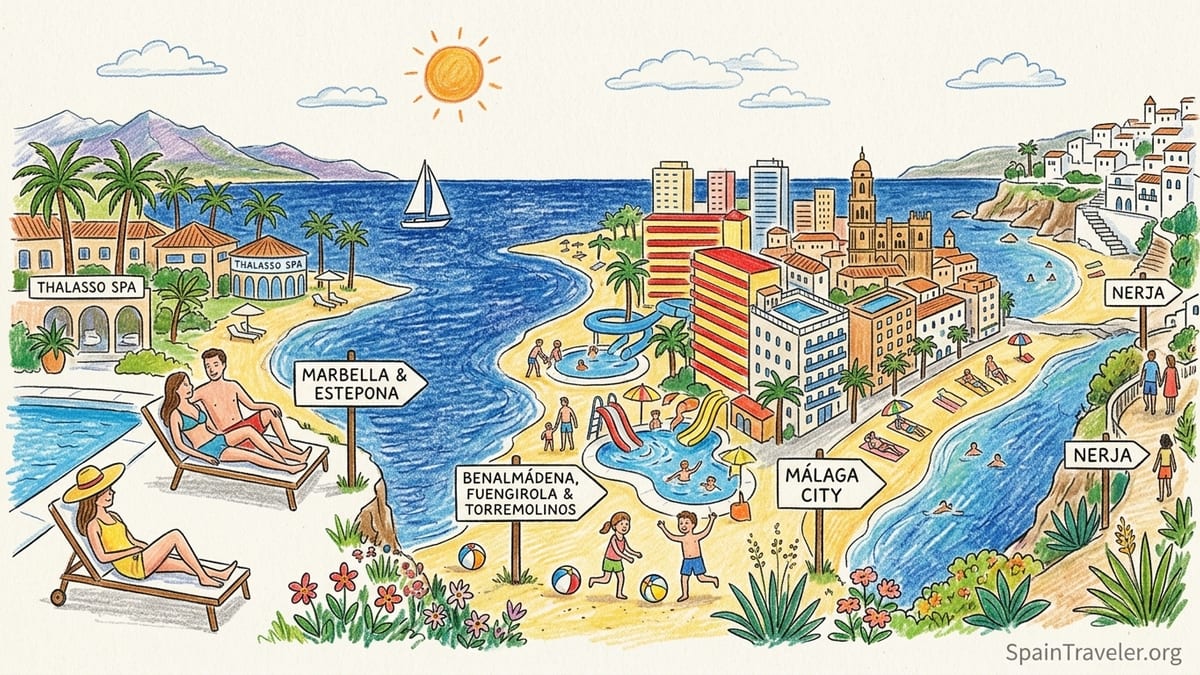
How to Choose Your Costa del Sol Base by Traveler Type
If you are booking the Costa del Sol for the first time, start with a simple question: what kind of trip is this? Couples seeking spa time and fine dining usually gravitate to the luxury beachfront corridor between Marbella and Estepona, where classic resorts such as Marbella Club and Puente Romano combine gardens, beach clubs and destination restaurants. Families who need kids’ clubs, splash pools and half-board or all inclusive often do better in Benalmádena, Fuengirola or Torremolinos, where large resort-style complexes are designed around children rather than late-night club scenes.
Urban travelers, short-break visitors and anyone arriving without a car tend to base themselves in Málaga city, where compact hotels with pools give fast access to both the historic center and Playa de la Malagueta or Huelin beach. At the quieter eastern end of the coast, Nerja suits those who value scenery and a slower pace, with small and mid-sized hotels looking down over coves like Burriana Beach rather than mega-resorts. In all cases, consider practicalities: parking if you are road-tripping, transfer time from Málaga Airport, and whether you want to wake up right on the sand or are content with a short walk.
Direct beach access is the key differentiator between properties that feel like true resorts and those that are simply coastal hotels. In Marbella and Estepona, many high-end addresses sit directly on the promenade with gates onto the sand, while in parts of Benalmádena and Nerja a number of hotels are one or two streets back. Families with buggies or older travelers with mobility issues will notice the difference when they move between pool, room and beach several times a day.
Luxury Beachfront Hotels: Marbella & Estepona
For classic luxury on the Costa del Sol, the stretch between Marbella’s Golden Mile and the western side of Estepona is where you find the flagship beachfront resorts. Marbella Club remains one of the best known, with mature gardens leading down to a beachfront club, two outdoor pools and a thalasso spa. It operates more like a low-rise village than a tower hotel, with suites and villas tucked among pine trees, and it draws couples and multi-generational families who want both beach access and a strong concierge operation to organize golf, riding or yacht days.
Next door, Puente Romano Beach Resort has evolved into what many repeat visitors describe as a complete ecosystem: a low-rise resort arranged around courtyards and pools, with direct access to the promenade and beach, a serious tennis club, a large selection of restaurants and a substantial kids’ club. It suits couples who want lively dining and bar options without leaving the property, as well as families who appreciate the ability to divide days between kids’ activities, spa treatments and long lunches by the sea. Expect to pay premium rates in high season, especially for suites with guaranteed sea views and access to quieter pool zones.
Between Marbella and Estepona, Ikos Andalusia has made a name as a high-end, largely all-inclusive resort that appeals to both style-conscious couples and families who prefer to fix most costs up front. Rooms and suites are set in modern blocks overlooking landscaped pools and lawns that run down to the beach. The resort focuses on a la carte dining rather than only buffets, branded drinks, and a large poolscape with separate children’s areas. Its location on the main coast road means transfer time from Málaga Airport is predictable, and on-site parking suits those hiring a car for day trips to Ronda or Málaga.
Closer to Estepona itself, Kempinski Hotel Bahía combines traditional five star features with a resort layout that pushes pools and gardens towards the sea. Families and couples share a sequence of outdoor pools, and upgraded rooms and suites add space for longer stays. You get direct beach access across the promenade, on-site spa facilities and several restaurants, yet you are still a short drive or taxi ride from Estepona’s old town for evenings out. The hotel works well for travelers who want a quieter alternative to Marbella but still within easy reach of that scene.
Family Beach Resorts: Benalmádena, Fuengirola & Torremolinos
For parents who want water slides, kids’ clubs and buffet dinners without committing to the highest luxury price bracket, the family-focused clusters around Benalmádena, Fuengirola and Torremolinos are usually the best fit. Properties here range from simple three star hotels with children’s pools to large four star resorts with multi-pool complexes, snack bars, daytime entertainment and evening shows. Many sit either directly on the seafront or just across the road, which keeps logistics manageable with pushchairs and beach toys.
In Benalmádena, resort hotels such as Benalma Costa del Sol offer all inclusive options with several restaurants, a rooftop bar, pool areas and a kids’ club. The seafront location allows families to move easily between beach time and the hotel’s own facilities, and the marina and cable car are a short taxi ride away for off-site days out. Package operators also run holiday village style properties inland from the coastal road near Benalmádena, where large pool complexes and organized activities compensate for a longer walk or shuttle to the beach.
Fuengirola is more urban, with a long seafront lined by mid and high-rise hotels and apartment-style properties. Here the trade-off is usually between space and resort-style facilities. Some larger hotels offer kids’ pools and supervised children’s clubs in peak season, along with breakfast or half-board, but not the full all inclusive model of self-contained resorts. Families often choose Fuengirola because the flat promenade is excellent for evening strolls with buggies and scooters, the train line gives easy access to Málaga city and the airport, and prices are usually lower than in Marbella in July and August.
Torremolinos, just south of the airport, has perhaps the highest concentration of large family resorts around Playamar and Los Álamos. Many of these hotels offer multiple pools, slides or splash areas, daily activity programs and half-board or all inclusive options. The short transfer time, often around 15 minutes by taxi from Málaga Airport, makes Torremolinos attractive for families with younger children or for short breaks. However, not every property has direct beach access; in some cases you cross a road or walk down a slope from the pool terrace to the sand, which matters if you are shuttling back and forth several times a day.
City-Beach Hotels in Málaga: For Short Breaks & Culture Lovers
Málaga has changed in the last decade from a transit hub to a city-break destination in its own right, and its hotel scene has followed. For travelers who want galleries, tapas bars and a proper urban stroll alongside a daily swim, city-beach hotels are a smart compromise. These properties usually sit either near Playa de la Malagueta on the eastern side or by Huelin and San Andrés beaches to the west, with rooftop pools, on-site parking and fast access to the old town.
Hotels around Malagueta focus on proximity to both the beach and the historic center. You can expect to walk 5 to 15 minutes to most major museums and the cathedral, then be back on the sand in time for a late afternoon dip. Many of these properties have compact rooftop pools and sun terraces that suit mornings or sunset drinks rather than full resort days. For city-focused visitors, breakfast-included rates are popular, leaving lunch and dinner free for exploring tapas bars and seafood restaurants along the promenade.
On the west side of the city, newer properties near Huelin beach, including mid and upper mid-range hotels with pools and optional parking, appeal to travelers who want a slightly more residential feel while still near the center. These areas are convenient for the airport and train station, often 10 to 15 minutes by car or taxi, which appeals to weekenders and business travelers adding a beach day. While you will not find large-scale water parks or kids’ club complexes here, families with older children who can entertain themselves may appreciate the combination of a city pool, beach access and cultural excursions.
For all city-beach options in Málaga, it is important to check walking distances and transport connections rather than relying on “near the beach” descriptions. A hotel that is technically a few blocks from the sea but on the far side of a busy junction will feel quite different from one on a quiet side street opening straight to the promenade. If you are arriving by hire car, confirm parking on site or in an attached garage; central street parking in summer is limited and controlled, and daily public car park costs can quickly erode any room rate savings.
Scenic Stays in Nerja: Clifftops & Coves
At the eastern end of the Costa del Sol, Nerja offers a different atmosphere: lower-rise development, dramatic cliffs and coves, and a compact whitewashed center around the Balcón de Europa. Instead of vast resort complexes you find a mix of mid-sized hotels, simple apartment buildings and a few more substantial properties perched above beaches like Burriana. Travelers come here for sea views, coastal walks and a town that still feels like a place rather than a purpose-built strip.
One of the most recognizable addresses is the Parador de Nerja, set on a clifftop with gardens leading towards the sea and its own elevator down to Burriana Beach. This combination of height and direct access makes it particularly attractive to couples and relaxed family groups who want views but do not want to tackle steep staircases in the heat. Facilities include outdoor pool, gardens and on-site restaurant, plus parking that makes it convenient for road trips along the coast and inland to the white villages.
Closer to the center, hotels and refurbished properties around Burriana and the old town often trade pure beachfront for an easy walk to both sand and restaurants. Many have rooftop pools, small spa corners and a mix of room types including family rooms or linked doubles. Parking is tighter here, so if you are driving it is worth prioritizing hotels with guaranteed spaces or clear guidance on nearby garages. Families with older children or couples on a budget often accept a short uphill walk from the beach in exchange for lower room rates and more local atmosphere.
Unlike the big family resorts west of Málaga, Nerja’s hotels rarely operate on a full all inclusive basis. Breakfast or half-board is more common, and many repeat visitors prefer to book room and breakfast only, using the hotel as a base while eating out in tapas bars and chiringuitos. For stays in July and August, it is sensible to book sea-view rooms well in advance, as the number of properties with genuine panoramic views and decent pools is limited compared with the mega-resorts further west.
Comparing Key Features: Beach Access, Pools, Dining & Parking
When comparing properties across the Costa del Sol, it helps to think in terms of a few concrete features that will shape your days. Direct beach access from the hotel grounds is the number one factor for many travelers. In Marbella and Estepona, top-end resorts such as Marbella Club, Puente Romano, Ikos Andalusia and Kempinski Hotel Bahía all open directly onto the promenade, with gates that lead straight to the sand or short boardwalks to their beach clubs. In Benalmádena and Torremolinos, some resorts are elevated one road back or up a slope, so “sea view” may still require a descent with pushchairs or beach bags.
Pool design is the second major consideration. Luxury properties around Marbella and Estepona usually focus on a smaller number of well-landscaped pools, often including a heated pool for shoulder seasons, a children’s area and quieter adult-focused sections. Family resorts further east often prioritize variety instead: larger main pools, splash zones with slides and water toys, and sometimes separate baby pools. Make sure photos match your expectations; a single rectangular pool behind a city hotel will feel different from a lagoon-style complex with bridges and shallow shelves for toddlers.
Dining and board basis can also change the feel of a stay. At the luxury end, breakfast-included with a choice of à la carte or buffet is typical, and guests are expected to explore outside restaurants or dine at a range of on-site venues, often with supplements for half-board packages. In Benalmádena, Fuengirola and Torremolinos you will find more half-board and all inclusive offerings that package breakfast, lunch, dinner and local drinks. This helps families control costs but can limit the incentive to explore local dining, so some travelers prefer flexible half-board, using included dinners on quieter nights and eating out on others.
Parking and transfer logistics matter more than many people realize. If you are hiring a car, resorts on the Marbella–Estepona corridor usually offer on-site parking or valet service, often at a daily fee. In Málaga and Fuengirola, garages and limited spaces are common, and you should assume an extra per-night cost if you want to avoid searching for street parking. For those skipping the car, Torremolinos and Málaga stand out because of their short transfer times and frequent train links with the airport, while Marbella and Estepona typically require private transfers or buses, adding both cost and complexity to late-night arrivals or early departures.
Kids’ Facilities & Spa Time: Balancing Family and Adult Needs
Parents often need to balance their own desire for rest with children’s energy levels, and the Costa del Sol’s hotel market now reflects that. At the top end, Marbella Club and Puente Romano illustrate how high-service resorts can operate substantial kids’ clubs alongside serious spa and wellness offers. At these properties, children’s programs might include craft workshops, sports, cooking classes and supervised play in shaded gardens, freeing parents for a few hours in the spa or on a paddleboard. Most activities are concentrated in school holiday periods and summer, so off-season guests should check schedules.
Ikos Andalusia and similar all-inclusive-leaning resorts around Estepona give families another model: structured kids’ clubs divided by age, baby-sitting or evening clubs for a fee, and splash areas or shallow pools built specifically for younger guests. Because so much activity is located on site, parents who do not want to drive every day can settle into an easy rhythm of breakfast, kids’ club drop-off, spa or gym, lunch together and afternoon beach time. These resorts suit families who value convenience over exploring a wide range of independent restaurants.
In Benalmádena, Fuengirola and Torremolinos, mid-market resorts tend to offer simpler but still useful kids’ options: mini-clubs for roughly 4–12 year olds in peak season, playgrounds, children’s pools and evening mini-discos. Facilities like water slides and splash parks vary considerably between hotels, so it is worth checking whether the slides are suitable for the ages in your group and if they operate all season or only in summer. Spa offerings in these areas are more limited, often compact wellness rooms with a sauna, small treatment menu and perhaps an indoor pool, but that can still allow a parent to book a massage while the other supervises pool time.
For families who prefer a quieter scene, Nerja’s mid-sized hotels and the Parador offer more modest kids’ facilities, typically family rooms, cots on request, and in some cases a small playground or children’s pool. Here the focus is on shared activities like beach days, coastal walks and ice creams in the square rather than supervised clubs. Parents who want dedicated spa circuits and wellness programs may find better value in Marbella or Estepona and use Nerja as a day-trip destination instead.
The Takeaway
No single Costa del Sol destination suits everyone. If you are a couple or extended family looking for top-service luxury and a resort you barely have to leave, the beachfront strip between Marbella and Estepona is where you will find the strongest concentration of high-end hotels with direct beach access, refined pools, strong dining and polished spas. Prices reflect that, particularly in July and August, but the experience can rival leading Mediterranean destinations.
Families with school-age children who want water play, easy meal routines and entertainment without breaking the bank often do better in Benalmádena, Fuengirola or Torremolinos, trading some of the polish of Marbella for kid-focused pools and more approachable room rates. Urban travelers and short-break visitors should look closely at Málaga city, where rooftop-pool hotels near Malagueta or Huelin beaches let you combine swims with museums and tapas, while Nerja remains the choice for lower-rise scenery and clifftop sea views.
In all cases, focus on concrete details rather than broad marketing phrases. Check whether the hotel’s beach access is genuinely direct, how many pools there are and whether any are heated outside high summer, what parking or transfer options exist, and how kids’ clubs or spa facilities operate seasonally. With that information in hand, you can match your travel style to the right town and resort type and make the most of the Costa del Sol’s long season of sun.
FAQ
Q1. Which Costa del Sol area is best for a first visit?
For a first trip many travelers choose Marbella or Benalmádena. Marbella offers polished beachfront resorts and a smart old town, while Benalmádena provides easier prices and very family-friendly facilities.
Q2. Is it worth paying extra for direct beach access at the hotel?
If you plan to spend most days between pool and sea, direct access is usually worth the premium, especially with children or older relatives. It saves time and effort compared with crossing roads or walking uphill.
Q3. Do I need a car to enjoy Marbella and Estepona?
You can manage without a car if you stay in a beachfront resort and are happy using taxis for trips into town. However, a hire car is useful for exploring inland villages and gives flexibility for restaurant choices.
Q4. Which resorts are best for families with younger children?
Large family hotels in Benalmádena, Torremolinos and parts of Fuengirola often work best, thanks to splash pools, simple kids’ clubs and half-board or all inclusive options that make meal planning easier.
Q5. Are Málaga city hotels suitable for a beach holiday?
Málaga city works well if you want a mix of culture and beach. City-beach hotels near Malagueta or Huelin offer pools and easy sea access, but they are not full-scale resorts with extensive kids’ facilities.
Q6. How far is Nerja from Málaga Airport and is it too far for a short break?
Nerja is roughly an hour’s drive from Málaga Airport in normal traffic. It is feasible for a three or four night stay, especially if you value scenery and a quieter atmosphere over urban convenience.
Q7. When is the best time to visit the Costa del Sol for warm pool and beach weather?
Late May to early October usually offers reliable pool and beach weather, with July and August hottest and busiest. In spring and autumn, look for hotels with at least one heated pool.
Q8. Are half-board or all inclusive plans good value on the Costa del Sol?
They can be, particularly for families in Benalmádena, Fuengirola or Torremolinos who want predictable costs. In Marbella and Málaga, many guests prefer breakfast only to enjoy local restaurants.
Q9. Which areas are best if I am traveling without a car?
Málaga city and Torremolinos are most convenient, thanks to direct train links with the airport. Parts of Benalmádena and Fuengirola also work well, provided your hotel is close to the seafront or station.
Q10. How far ahead should I book in peak season?
For July and August, aim to book popular beachfront resorts and sea-view rooms several months in advance. Smaller hotels in Nerja and high-demand family resorts can sell out early for school holiday weeks.